Kowalski’s torture, interrogation, and death
The Day of the JackalKowalski’s torture, interrogation, and death mark the brutal conversion of a captured man into a reluctant source of intelligence. Held in a cellar, he endures a calculated electrical assault and breaks at 4:10 in the afternoon. His answers are fragmented and incoherent, but the interrogation’s questions expose what the authorities are trying to learn about Marc Rodin, Montclair, and Casson, and a tape of the session is hurried to the Action Service.
The Interrogation’s Setting
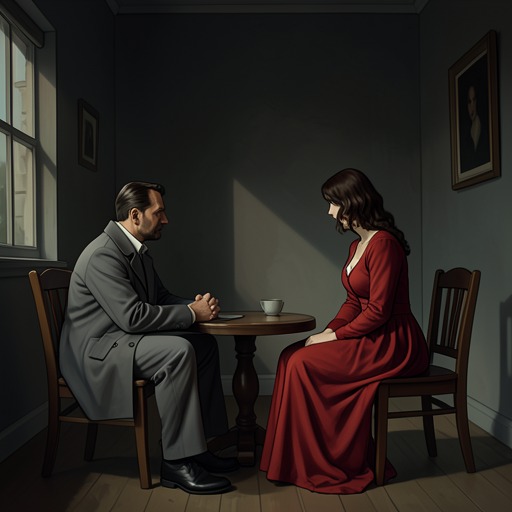
The scene confines attention to a single pool of light around Kowalski and the heavy oak chair to which he is strapped. A powerful reading lamp, clipped to the edge of a table six feet away, shines directly at him. The cellar’s size and the colour of its walls remain unseen; beyond the light, the room is darkness. The five men behind the table are therefore initially present less as individuals than as a row of hidden bodies. The light makes Kowalski visible while withholding his questioners from him.
The sensory details sharpen that imbalance. The men are in shirtsleeves, rolled high and damp with sweat. The air carries sweat, metal, stale smoke, and vomit, with fear and pain described as the strongest reek. Kowalski’s breathing is ragged. The scene does not begin with a blow but with silence, the bright circle around the prisoner, and the controlled breathing of the men who hold power over him.
Pressure and Torture
One of the questioners begins in a gentle, coaxing manner. He acknowledges Kowalski’s courage and tells him that he will eventually talk, arguing that continued resistance will only prolong his suffering. He invokes Rodin, suggesting that Rodin would order Kowalski to speak and spare him further discomfort. The appeal is not simply to physical weakness: it attempts to make continued silence seem disloyal to the very man Kowalski is presumed to protect.
The questioning turns repeatedly to a hotel in Rome: what the men there are doing and waiting for. The interrogator also asks about their earlier movements, whom they have seen, and their presence in Vienna, including which hotel they used. Kowalski does not answer at first. His bruised face is raised into the light; his eyes are closed, and he can manage only a failed attempt to speak before his head sinks back against his chest.
The violence is administered through small metal devices attached to his body and wired to an electrical switch. One man moves a brass control from figure two to figure four; another gives the signal to proceed. The devices begin to buzz. Kowalski’s body strains against the straps, his wrists and legs swelling against their restraints, and he screams. The clinical arrangement of lamp, switch, wires, and measured control settings makes the assault appear organized rather than impulsive. The men can vary the current and continue the process while keeping the prisoner fixed beneath the light.
Breaking and Death
Kowalski breaks at 4:10 in the afternoon. The narration presents the moment through his body’s response and the sound of the scream, then shifts to what follows: he begins to talk, but his speech is a rambling mixture of whimpers and squeaks rather than a clear account. The questioner cuts through it with focused prompts about Rome, Rodin, Montclair, Casson, Vienna, and the group’s movements. The contrast between the interrogator’s precise questions and Kowalski’s disordered speech defines the limits of what the torture has obtained.
His final silence comes after fifty minutes of rambling. The tape continues to capture his last words as he relapses, and the central questioner keeps speaking more gently for several minutes, apparently waiting to see whether he will answer again. When it becomes clear that no further answers are coming, the man gives an order and the session ends. The account identifies the episode as Kowalski’s torture and death, while its immediate closing image is not a declaration but the cessation of speech and the end of the interrogation.
The Recording and Its Consequences
The tape is removed from its spool and rushed by car from the cellar beneath the fortress to the Action Service’s offices on the outskirts of Paris. There, men work through the recording, repeatedly switching between playback and rewind and listening to short passages again to distinguish meaningful words from the jumble. The transfer of the tape makes the interrogation part of a larger intelligence effort: the prisoner’s suffering is converted into material to be reviewed and interpreted by people who were not present in the cellar.
The later investigation shows the wider stakes surrounding that effort. Claude Lebel asks foreign police forces for help in finding an as-yet-unnamed man, stressing that the suspected figure would have to be a professional political assassin with successful killings behind him. At a subsequent conference, Lebel explains that the killer has his own timetable and that the authorities do not know where they have entered it. These investigative developments do not make Kowalski’s answers legible in themselves; rather, they underline the urgency of obtaining usable information before the plot advances.
Significance in the Plot
The episode places the novel’s intelligence contest inside a scene of physical coercion. The questioners want locations, movements, and intentions; Kowalski’s broken speech gives them no clean, self-contained account. The tape preserves the sound of that failure as well as whatever words can be recovered, and its journey from the cellar to the Action Service turns the interrogation into an object of institutional analysis.
The scene also establishes a severe contrast between the hidden prisoner and the concealed men questioning him. Kowalski is held in the light, exposed and unable to see his interrogators clearly, while their power is expressed through calm speech, technical control, and the authority to stop or resume the current. His death closes the possibility of obtaining further answers from him, leaving the investigators to work from the recording and from uncertain deductions as they pursue the assassination plot.